

Aug 10, 2025
Nanotechnology Cleanroom Design, Standards, and Best Practices
Introduction
As nanotechnology continues to drive innovation in electronics, medicine, and materials science, the need for precision-controlled environments has never been greater. Cleanrooms used in nanotechnology must go beyond conventional cleanliness standards due to the extreme sensitivity of nanoscale processes. At the atomic and molecular level, even the smallest contaminant—whether a particle, molecule, or vibration—can lead to defective products or failed research outcomes.
To maintain integrity in nanomanufacturing and research, these environments require advanced airflow management, contamination control, and rigorous adherence to ISO cleanroom classifications. This article explores the critical elements of nanotechnology cleanroom design, applicable standards, and best practices for creating high-performance nanotech facilities.
ISO Cleanroom Classifications for Nanotechnology
Nanotechnology cleanrooms typically operate at ISO Class 5 or lower, depending on the sensitivity of the process and equipment used. ISO 14644-1 defines cleanliness by particle size and count per cubic meter:
- ISO Class 5: ≤3,520 particles (≥0.5 μm) per cubic meter.
- For nanoscale fabrication, particle sizes <0.1 μm are also a major concern.
These requirements are significantly stricter than those for industries like pharmaceuticals or food production, where ISO Classes 7–8 may suffice for non-sterile operations. In nanotech, even ultrafine particles and molecular contamination must be controlled due to their ability to interfere with sub-micron features and precision instruments.

Contamination Control at the Nanoscale
At the nanoscale, traditional particle control is only part of the challenge. The following forms of contamination are equally critical:
- Airborne particulates: Dust, skin flakes, and fibers can easily exceed feature sizes in nanoelectronics or microfluidic devices.
- Molecular contamination: Includes outgassed organics from materials, lubricants, or cleaning agents, which can cause thin-film defects or reduce yields.
- Electrostatic discharge (ESD): In nanoelectronics, ESD events can permanently damage circuits. Grounding protocols and antistatic materials are essential.
- Vibration and acoustic sensitivity: Lithography, microscopy, and atomic-level positioning tools are highly sensitive to sub-micron mechanical disturbances, making vibration isolation and acoustic dampening essential.
Key Features of a Nanotechnology Cleanroom
To effectively support nanoscale processes, a cleanroom must incorporate a range of advanced features:
- Airflow Control: Laminar (unidirectional) flow in critical zones ensures uniform, particle-free air distribution. Turbulent zones are minimized or isolated.
- HEPA/ULPA Filtration: Ultra-Low Penetration Air (ULPA) filters may be required to capture particles <0.1 μm, especially in ISO 4 or better environments.
- Zonal Pressure Differentials: Controlled pressure gradients help prevent backflow and cross-contamination between cleaner and dirtier zones.
- Antistatic Materials: Floors, benches, and equipment are often made from conductive or dissipative materials to reduce ESD risks.
- Environmental Controls: Tight regulation of temperature, humidity, and barometric pressure ensures thermal and chemical stability.
- Personnel Protocols: Full-body suits, face shields, and multiple gowning stages are required to limit human particle shedding and static charge.
Facility Layout and Zoning Considerations
Nanotech cleanrooms benefit from careful zoning and workflow design to support cleanliness and operational efficiency:
- Unidirectional workflow: Materials and personnel should only move from less clean to more clean areas—never in reverse.
- Airlocks and transfer hatches: Help isolate changes in pressure and prevent contamination from entering higher-grade zones.
- Material and equipment segregation: Dedicated carts, tools, and storage areas minimize cross-contamination risks.
- Zoning strategies: For example, high-precision tools (e.g., e-beam lithography) may be housed in ISO 4 or 5 zones, surrounded by ISO 6 or 7 environments to support staging and personnel access.
Prefabricated Cleanrooms for Nanotechnology Applications
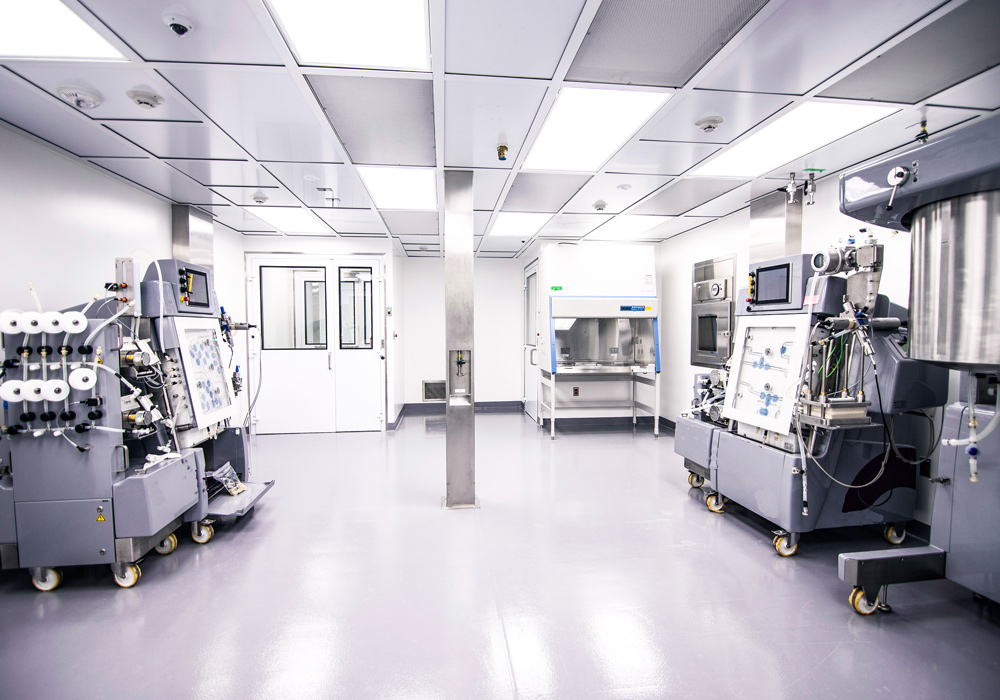
Prefabricated cleanroom systems—such as G-CON POD® Cleanrooms—offer a compelling alternative to conventional stick-built facilities, especially for nanotech R&D and scalable manufacturing:
- Faster deployment: Prefabricated cleanrooms reduce construction time and minimize site-based particle generation.
- Customization: Units can be designed for microscopy suites, lithography zones, or nanoassembly lines with specific zoning, vibration isolation, and environmental specs.
- Utility integration: Prefabricated units allow plug-and-play connectivity with HVAC, gases, power, and deionized water systems.
- Scalability: Ideal for research labs scaling up to production or for industrial settings requiring distributed cleanroom nodes.
Compliance and Validation
Nanotechnology cleanrooms must meet international and industry-specific standards for classification, operation, and testing:
- ISO 14644 series: Defines classification by particle count, testing methods, and cleanroom design principles.
- SEMI Standards: Provide guidelines specific to semiconductors, MEMS, and nanofabrication environments.
- GMP/FDA alignment: In cases where nanotech is used in drug delivery or medical devices, cleanrooms must also align with cGMP principles and FDA guidance.
Validation protocols: Include Installation Qualification (IQ), Operational Qualification (OQ), and Performance Qualification (PQ), as well as ongoing monitoring and periodic requalification.
Industries and Applications Benefiting from Nanotech Cleanrooms
Nanotechnology cleanrooms are vital across a wide range of high-precision industries:
- Semiconductors and Microelectronics: Fabrication of sub-5nm chips and nano-patterned wafers.
- MEMS/NEMS Devices: Micro and nano-electromechanical systems used in sensors, robotics, and diagnostics.
- Biomedical and Pharmaceutical Nanotech: Including nano-carriers for drug delivery and bio-nano interfaces.
- Advanced Coatings and Materials: Nanostructured films, graphene, quantum dots, and other novel materials.
- Academic and Private R&D Labs: Where prototyping and small-batch production require tightly controlled environments.

Closing: Investing in High-Precision Cleanroom Infrastructure
The success of nanotechnology manufacturing and research depends heavily on the cleanliness, stability, and flexibility of the cleanroom environment. At the nanoscale, a single particle or trace contaminant can derail a critical process.
Organizations that invest in ISO-classified, vibration-isolated, prefabricated cleanrooms gain a strategic advantage in innovation, time-to-market, and process yield. Whether you’re developing nano-enabled pharmaceuticals or next-gen semiconductors, cleanroom infrastructure is not a cost—it’s a core enabler of progress.
Explore scalable cleanroom solutions tailored to your nanotech applications.
FAQ
What ISO class is required for nanotechnology cleanrooms?
ISO Class 5 or better is commonly required, depending on the sensitivity of processes. In many cases, subzones may operate at ISO 4 or ISO 3.
What makes nanotechnology cleanrooms different from pharmaceutical cleanrooms?
Nanotech cleanrooms focus more on molecular contamination, vibration isolation, ESD protection, and ultrafine particle control. Pharma cleanrooms prioritize microbial control and sterility.
How often should nanotech cleanrooms be tested and validated?
Regular monitoring is required, with full validation typically performed annually or whenever significant process or layout changes occur.
Can prefabricated cleanrooms support nanofabrication tools?
Yes. Modern prefabricated cleanrooms can be designed to support lithography, electron beam tools, and other vibration-sensitive equipment.
What kind of personnel training is needed in a nanotech cleanroom?
Personnel must be trained in gowning, particle and static control, contamination sources, and cleanroom protocols. Advanced environments may also require ESD certification and vibration awareness training.
